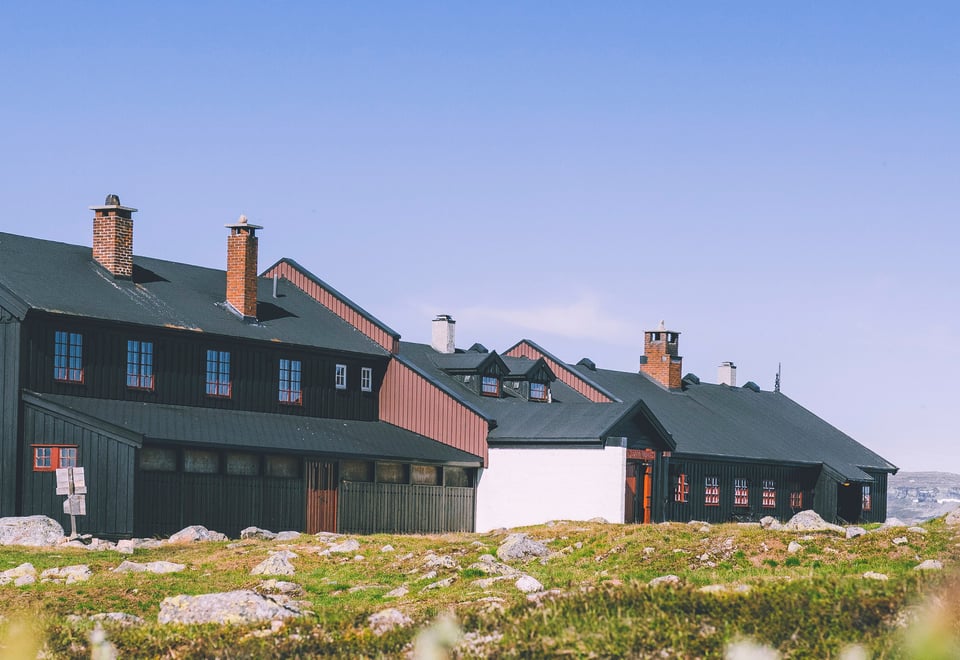
The Norwegian Trekking Association (DNT) established its first cabins on Hardangervidda early on.
In 1890, Sylfest Kvammen from Eidfjord built a small cabin near Nordmannslågen, the geographical center of Hardangervidda, supported by a NOK 600 grant from DNT. The association held a mortgage on the property, which was named Sandhaug after a nearby hunting lodge. In 1893, DNT purchased the cabin entirely for NOK 883.
Historical Cabins and Early Use
The area surrounding the lodge has long historical roots:
Holsbu: An old stone hut traditionally used by fishermen and hunters. Its oldest section, Holmsbu, was originally a fishing hut located on an islet before being moved further east around 1730 to serve as a hunting shelter (veidebu).
Livestock Shelter: A herding camp (feleger) was established in the area in 1831.
The Amundsen Expedition: An excerpt from the 1896 annual report notes: "Two skiers who crossed Hardangervidda in 1895 found it necessary to force their way into the cabin. They immediately reported the matter and paid for the damage caused." These skiers were the famous polar explorers Roald and Leon Amundsen.
Expansions and Relocation
1899–1924: The original cabin was expanded in 1899, 1915, and 1924. A separate stone hut was constructed for the staff in 1899.
1924–1929: Due to a failing foundation on unstable ground, a new site was chosen in 1924, located roughly 1 km north of the original cabin. Construction was approved in 1926, and the new 48-bed lodge opened in July 1929.
1930: The name was briefly changed to Normannslåghytta, but due to local unpopularity, the original name Sandhaug was restored the following year.
1949: Major renovations and expansions increased the capacity to 60 beds.
1979: Architect Henrik Biong designed a comprehensive modernization plan. Construction began in 1979, following a demanding winter transport operation led by the manager, Sylfest Sæbø. Total costs reached NOK 6 million.
Historical Managers (Hosts)
Sylfest Kvamme: 1893–1898
Lars Sylfestsen Sæbø: 1899–1903
Sylfest Sæbø: 1904–1919
Nils Høel: 1919–1950
Lars Høel: 1951–1956
Lars Sæbø: 1956–1958
Marit and Sylfest Sæbø: 1958–2004
Rigmor and Edvar Sæbø: 2004–2008
Brita Gjerde and Jan Tyssebotn: 2008–2020
Svein Arne Tyssebotn: 2021–present
Ancient Monuments and Archaeological Sites
The landscape surrounding Sandhaug contains numerous traces of ancient hunting and trapping:
Pitfall Traps: Ancient pitfall traps (dyregraver) used for hunting wild reindeer can be found near the Trondavanutene peaks.
Stone Age Sites: Archaeological excavations of Stone Age trapping systems have been conducted near the canal west of Nordmannslågen, close to Holsbu, and on the peninsula on the western side of the lake.
The Old Site: The archaeological remains (tuften) of the original 1890 Sandhaug cabin are located on a promontory south of the Holsbustrykene rapids.
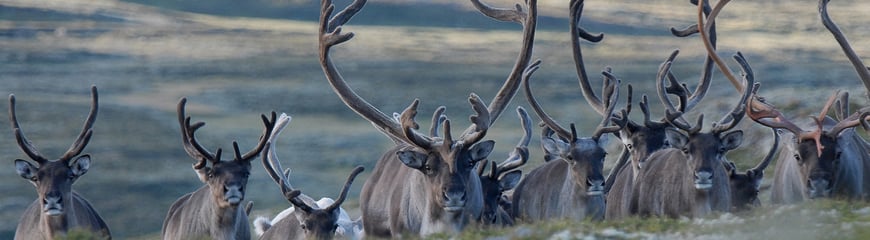
Show Consideration for Wild Reindeer
The natural habitats of Europe’s wild reindeer are facing unprecedented fragmentation. As a hiker, understanding how to minimize your impact is essential when traveling through these vulnerable alpine ecosystems.