Gaustatoppen Turisthytte: A Historic Mountain Cabin
Gaustatoppen has attracted visitors for nearly 200 years. The peak is known for its distinctive landscape and panoramic views of Southern Norway.
Gaustatoppen Turisthytte in Brief
History: An early destination for both Norwegian and international tourists, playing a key role in the development of Norwegian mountain tourism.
Infrastructure: Features both a stone cabin at the summit and the Gaustabanen funicular inside the mountain, which was built during the Cold War.
Terrain: Steep and rocky, consisting primarily of quartzite (a hard, ancient sandstone). Sturdy footwear is highly recommended.
Wildlife and Livestock: Sheep graze in the mountains during summer, and the area is part of a wild reindeer habitat. Visitors must pack out all waste and strictly observe leash laws.
Gaustatoppen (1,883 meters above sea level) towers over Rjukan. The summit is highly accessible and offers some of the most extensive views in Southern Norway. On a clear day, approximately one-sixth of mainland Norway is visible from the top.
Every year, more than 120,000 people hike to the peak. Its characteristic white-striped, elongated ridge can be seen from large parts of Southern Norway, and its proximity to central parts of Eastern Norway makes it a highly popular hiking destination.
The mountain consists mostly of large scree and rock masses held in place by permafrost.
The local population has used the Gausta area for agricultural farming and grazing for generations—a tradition that continues today. Hikers frequently encounter sheep during the summer months. Because the area also lies within a wild reindeer migration zone, considerate travel and strict compliance with dog leash laws are required.
The History of Gaustatoppen and the Cabin
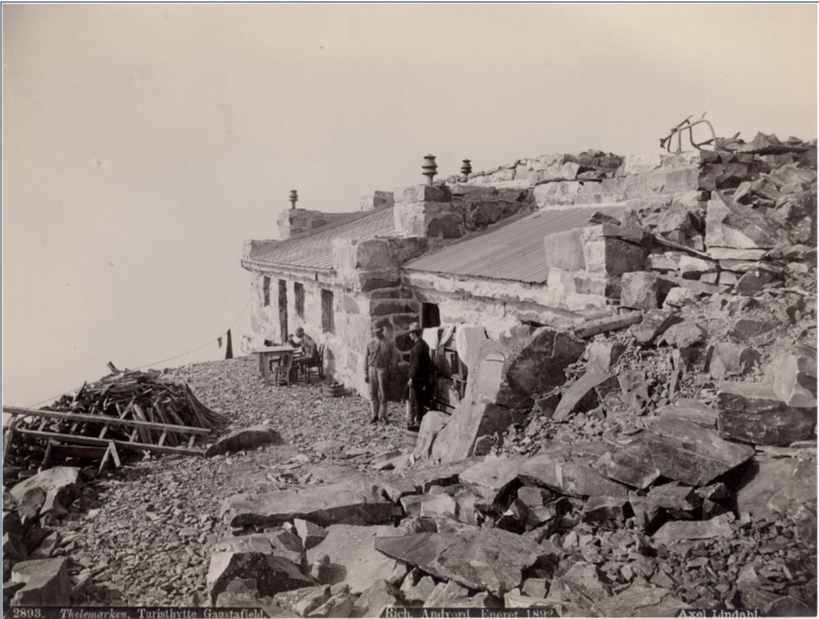
Photo: Construction of the cabin at the summit, 1892.
The first documented ascent of Gaustatoppen took place in August 1810 by the geologist Jens Esmark and the botanist Christian Smith. At the time, they were surveying the area to locate Norway’s highest peak. Throughout the 1800s, mountain tourism grew rapidly, drawing international guests to Rjukan to experience the waterfalls and mountain landscape.
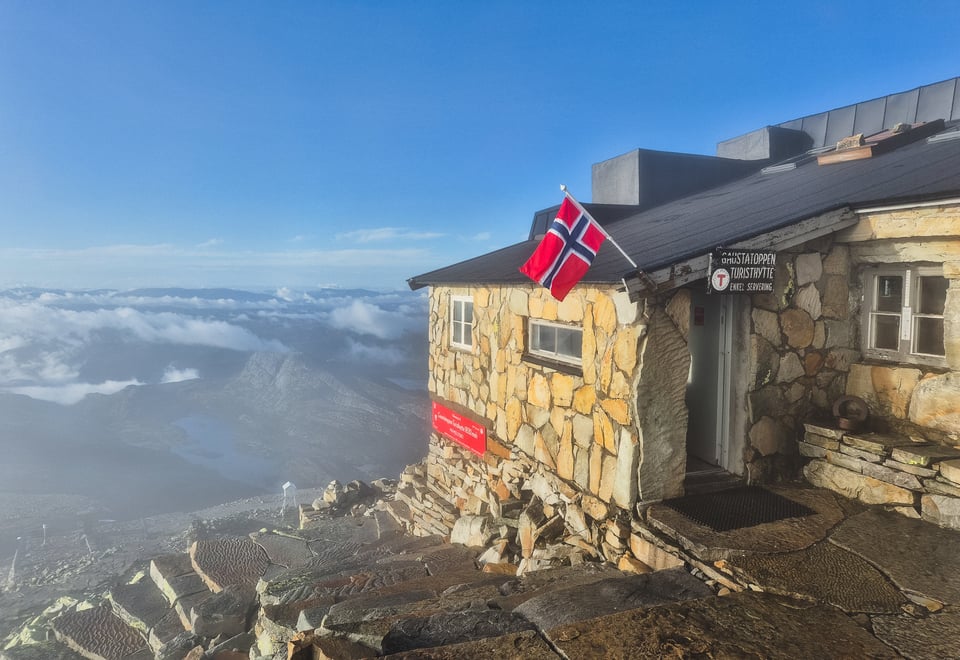
When the Skien-Telemark Trekking Association was founded in 1887, marking a trail to the summit of Gaustatoppen was one of its first initiatives. The cabin was built using local natural stone and received 500 visitors in its opening year. The first manager was Rikka Lund. The cabin remained largely unchanged until 1997, when it was expanded and upgraded to a modern standard with indoor toilets, increased accommodation capacity, and improved kitchen facilities.
The summit area also features a 68-meter-high telecommunications tower and Gaustabanen. Built inside the mountain during the 1950s, the funicular was originally constructed to service radio and television broadcasts before being utilized by NATO for military operations. In 2010, the railway opened to the public and currently transports tourists and equipment to the summit.
Today, Gaustatoppen offers a combination of hiking, historic overnight accommodation, and food services with panoramic views.