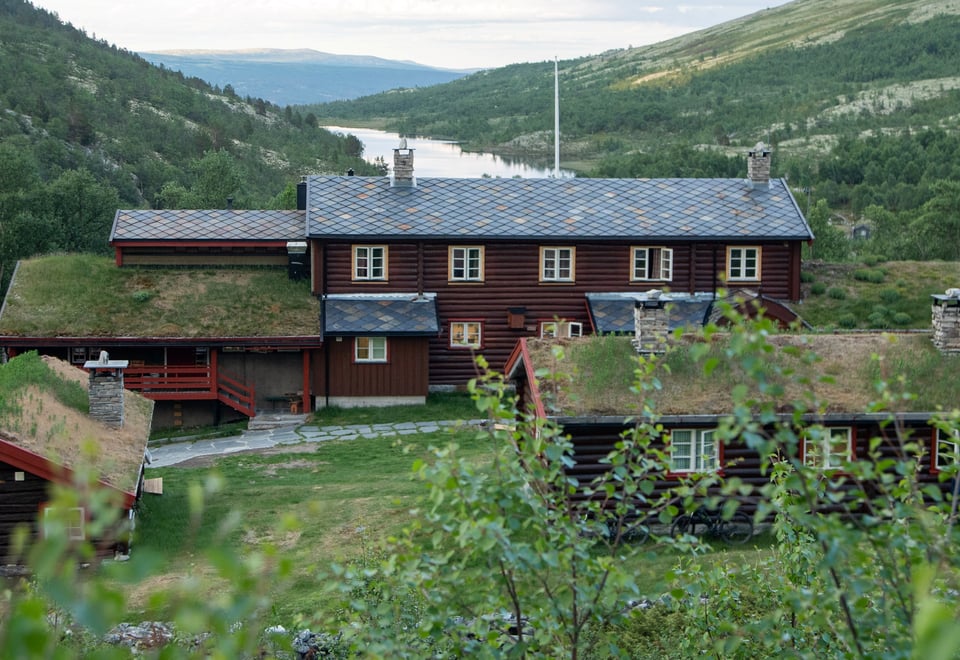
Although Bjørnhollia is one of the Norwegian Trekking Association's (DNT) younger serviced lodges, hikers have visited this part of eastern Rondane throughout the organization's history. In 1860, eight years before DNT was founded, the poet Aasmund Olavson Vinje trekked through the valley to Folldal and Hjerkinn—a journey that inspired his famous poem, "Ved Rondane".
Long before permanent settlements were established in Atndalen around 1750, the mountains around Bjørnhollia were used by local farmers from Gudbrandsdalen for seasonal fishing and grazing. Archaeological evidence of wild reindeer trapping pits also shows that the area has been used for hunting since the Stone Age.
Establishment of the Summer Farm (Sætra)
The distinct natural terraces in the landscape made the site an ideal location for a summer farm. In 1714, three farms from Sel (Loftsgård, Øvre Dale, and Øvre Veggem) were granted permission to clear a summer pasture in Musvoldalen. In 1873, Iver Wålen, a master builder from Gausdal, constructed a farmhouse and a large stone barn on the site. A stone inscribed with "IW 1873" from the original barn wall is preserved near the current guest house.
As mountain tourism grew, early hikers began staying overnight at nearby farms like Nesset and Straumbu. The first dedicated lodge in the area was established at Musvoldsæter around the turn of the century.
DNT purchase
In 1922, the farm was leased by Hanna and Johannes Øyen from Atndalen. The seasonal farm tourism provided essential income for their large family, supplemented by winter grouse hunting. By the 1930s, three small lodges were operating within a short walk of each other.
Bjørnhollia was the smallest of these facilities when DNT purchased the property in 1941. Reconstruction plans were drawn up during the war by architects Henrik Nissen and Gunnar Brynning, and building materials were logged and transported by horse during the winters of 1945–1947.
Construction of the Main Lodge
In the spring of 1947, local craftsmen from Sollia began log-building the main lodge using a labor-intensive, oval-log technique primarily known from Telemark and Setesdal. The lodge officially opened for the summer season in 1948. A new cart road down to Lake Atnsjøen significantly simplified transport, which had previously relied on packhorses. By 1952, the complex provided 48 beds and dining capacity for 40 guests.
Infrastructure Development
In 1959, Jenny and Hans Øyen took over management of the lodge. The construction of a tractor road in 1966 marked a significant turning point, allowing for fresh and frozen food supplies and the transport of pre-cut firewood from the valley, replacing local logging.
Capacity Expansion
Guest numbers rose sharply through the 1970s. Management passed to Storm Øyen in 1972, who was joined by Hilde Fridtun Øyen in 1985. The old barn was demolished to make way for a new guest wing and modern toilets, which opened for Easter 1982. The main lodge was expanded the following year, bringing the facilities to their current layout. Annual overnight stays increased from 4,000 to a peak of 8,000 by 1989. In 1992, a modern generator was installed, introducing heat-recovery technology to supply hot water while reducing noise and emissions.
A New Generation of Hosts
In 2000, management left the Øyen family for the first time since DNT’s acquisition. Beate Øygarden and Svein Aaseng took over as hosts for Easter 2000, relocating from DNT's Liomseter cabin in Gausdal Vestfjell.
The name Bjørnhollia is derived from the local dialect term Bjøynnollie, where ol refers to a scree or boulder field rather than a cave or hollow, meaning "the bear in the scree."