Ski touring and steep skiing are becoming increasingly popular. But do you know how to reduce avalanche risk, what equipment to bring, and what decisions to make along the way?
Here is a practical introduction to safer travel in avalanche terrain.
Make safe route choices
Whether you follow marked routes, snowmobile tracks, or travel on your own, you must be able to choose safe terrain.
The most important skill is to recognise avalanche terrain — and avoid it when necessary.
Some basic avalanche guidelines:
Avalanches can occur on slopes steeper than 30° with a height difference of more than 5 meters.
You can trigger avalanches from flat terrain if there is a steep slope above you.
An avalanche may travel up to three times the height of the slope.
For example, if a snow-covered mountainside is 100 meters high, you should keep at least 300 meters away to remain outside the runout zone.
On open plateaus and in generally gentle terrain, this basic knowledge can help you travel more safely with regard to avalanche risk.
Want to learn more? Sign up for an avalanche course with DNT: Avalanche course
Planning is essential
If you still want to go into terrain that is prone to avalanches, you must learn to consider whether there may be an avalanche today on the particular trip you want to take.
You need to ask, and be able to answer, the following question:
What kind of trip can I do in these conditions with this group?
When you ask this question, you are doing trip planning. Good trip planning is the key to a long life in the mountains, and is something that goes on all the way - in advance, when you arrive at the hiking area, along the way and until you are back in the tent or cabin.
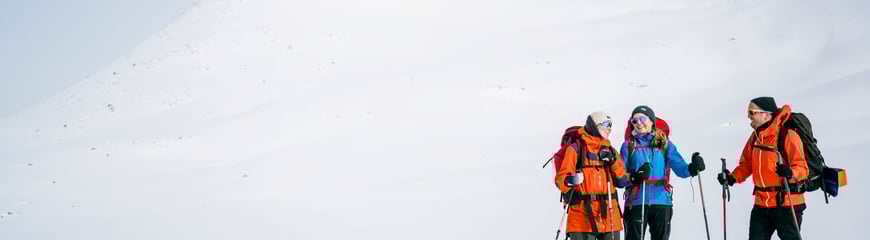
If you are going to travel in challenging avalanche terrain, do it in a smaller group of good skiing buddies.
With regard to the risk of avalanches, we are particularly concerned with three factors:
Terrain
This is the easiest factor to manage.
You can reduce risk by:
Avoiding slopes steeper than 30 degrees
Staying clear of runout zones
The people who are on the trip
Human factors are involved in many accidents.
Manage this by:
Choosing trips that match the group’s skills and experience
Being honest about limitations
Looking out for each other
Travel with trusted partners who communicate openly and make safe decisions together.
Snow and weather conditions
This is the most complex and variable factor.
Avalanche risk increases with:
Heavy snowfall
Strong wind (transporting snow)
Rapid temperature rise
Rain or strong sunlight
These conditions can quickly destabilise the snowpack.
Bring a ski buddy
The human factor is the one that mostly strikes when lives are lost in the mountains, and thus as important as it is difficult to get a grip on. We can handle the human factor by choosing a trip based on the group's skills, experience and motivation.
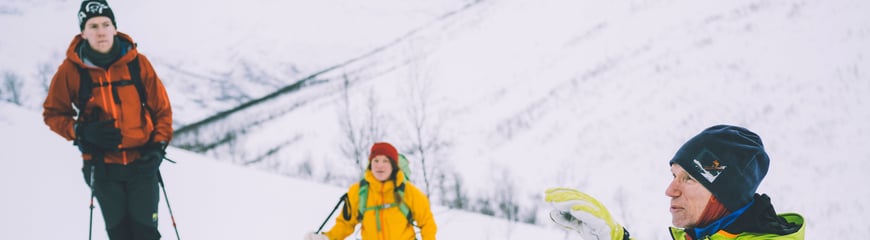
If you are going to travel in challenging avalanche terrain, do it in a smaller group of good skiing buddies. A skiing buddy is honest about their own needs and limitations and has the desire and energy to take care of their friends.
Avoid terrain steeper than 30 degrees. Remember that there may be risk factors that you do not see.
Be careful with the weather
Snow and weather conditions are the most variable factor (almost no day is the same), and are the one that requires the most insight and experience to get a grip on.
The avalanche risk increases during heavy snowfall, when it is windy so that the snow is moved, when the temperature rises rapidly; by solar radiation, rain or ingress of hot air. Based on such general observations, you can choose to go hiking in clear terrain. If you are still looking for challenging terrain, the trick is to know any weak layers and understand whether these pose a relevant avalanche problem.
Such an avalanche problem can be described as a "Persistent weak layer" or "Drift snow". On varsom.no there are good descriptions of the various avalanche problems and suggestions for how these can best be handled on a trip. Drift snow is easier to identify (it is located at the top), than, for example, a weak and thin layer down in the snow cover.
Avalanche expertise for ski touring
Here you will get an introduction to avalanche skills that we recommend you have before you go on a summit trip this winter.
The regional forecast for varsom.no gives a degree of danger for a large area based precisely on the prevalence of one or more known avalanche problems. It is therefore very important that you read the text of the notification and make your own assessments locally and for individual cases.
The forecast on varsom.no can be used to choose a safer terrain, but is also helpful in knowing what to look for if you are dealing with challenging avalanche terrain.
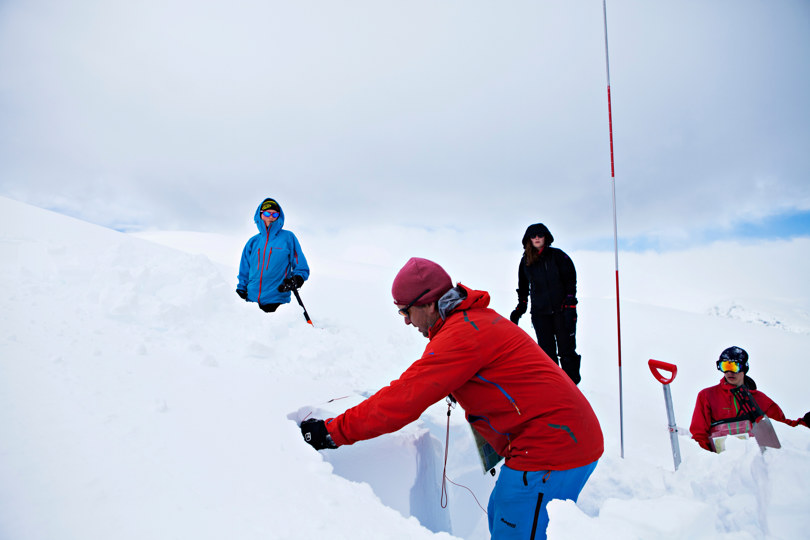
If you want to travel safely where avalanches can break loose, you must do snow investigations yourself, and not least, you must understand why the problem has arisen if you are to substantiate what the conditions are like elsewhere on the planned route.
Suppose it is rain that has caused a weak layer in connection with the crowd. Does this problem only apply here – or all the way up to the top? This is demanding. Therefore, always avoid challenging avalanche terrain where the predicted avalanche problem is persistently weak layers.
Always avoid challenging avalanche terrain where the predicted avalanche problem is persistently weak layers.
No simple rules
If you want to travel reasonably safely in steep winter snow, there are no simple rules that guarantee you free passage. You must have practical knowledge and most importantly use this knowledge to reflect on safe choices.
Stay awake by wondering and feeling the joy of mastering the mountain rather than the euphoric relief of constantly surviving without quite knowing why.
Alarm signs
That said, there are observations that are more important than others when traveling on layered winter snow. In particular, one or more of three observable phenomena almost always occur both BEFORE and WHEN one of the group triggers a fatal avalanche.
Recent or recent avalanches in the area are a sure sign of avalanche risk. If you hear a roar in the snow cover, you are dealing with a weak layer that collapses because you walk there. This is how a flake avalanche occurs. The load simply exceeds the load capacity.
If you hear the rumble of just loading a flake, you know that the snow cover can withstand little additional load. Does it crack up around you when you load the snow cover? This means that the snow is bound and able to propagate the energy you release into the snow cover by walking or driving there.
In other words, the most important advice is to be alert, register and process at least these three alarm signs, and make choices and leave tracks that reduce the significance of your visit.
Be safe - follow your back
The pun "Be safe - follow your back" describes a typical choice of route that reduces the risk of triggering avalanches. On the mountain ridges, the snow will blow away. Even in winters with heavy snowfall, you will find mountain ridges that are almost free of snow.
If your goal is good skiing, you need to know the snow conditions, be able to read the terrain and, not least, have a good skiing buddy with you. You will also need a shovel, probe and avalanche transceiver, and not least, good knowledge of how to use the equipment.
Or much simpler: Choose terrain below 30 degrees. Then you know for sure that you can do the same tomorrow.
You should have this avalanche expertise
If you are going on a summit trip in winter, you must be able to recognize and avoid avalanche-prone terrain. Here you will find information about what avalanche knowledge is recommended for trips within the three different terrain classes: Easy terrain, challenging terrain and complex terrain.
Read more about avalanche terrain, route choice and track laying in Nes, C. L. (2013). Ski buddy. Førde: Selja Forlag.
Read more about why we humans ignore obvious danger signs: McCammon, I. (2002) Evidence of heuristic traps in recreational avalanche accidents. National Outdoor Leadership School, Lander, WY, USA
Check avalanche and weather forecasts at varsom.no