Hiking in a Thunderstorm: Safety tips for lightning on the hike
What should you do if a thunderstorm catches you by surprise on a hike? Discover essential safety advice, common myths, and practical steps on how to stay safe from lightning when hiking in the mountains or forests.
In recent years, summer has been the peak season for lightning in Norway. In July last year alone, a couple of hundred thousand lightning bolts striked across Norwegian fjords, forests and mountains.
While lightning can occur at any time of the year, it develops most frequently within storm clouds during hot summer weather.
For outdoor enthusiasts, one question often arises when thunder rumbles: Is it dangerous to be outdoors during a storm?
Warning signs you should take seriously:
A crackling sound in the air
Static shocks when touching objects
Your hair standing on end
If you experience any of these signs while hiking, you should immediately seek shelter.
But what does "shelter" mean when you are out in the wilderness?
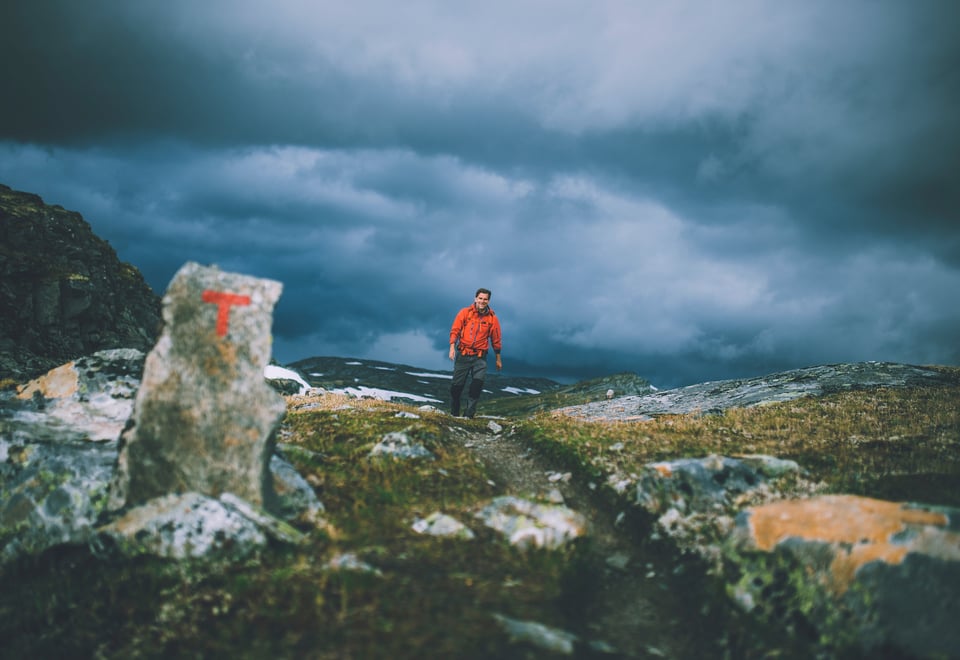
According to experts, lightning is unpredictable, but it frequently strikes high objects. If a storm approaches, your priority should be to descend from high, exposed areas such as mountaintops, ridges, and open hills.
What to do during a thunderstorm on a hike:
Seek shelter in a car, house, or cabin if possible.
Descend immediately from high, exposed points like peaks and summits.
Avoid tall, isolated objects such as single trees, towers, or large boulders.
Stay low if you must keep moving, and avoid becoming the highest point in the landscape.
Spread out the group if you are hiking with others, to minimize the risk of a single strike affecting multiple people.
What if you're on a mountain top and cannot descend or seek shelter?
If you cannot escape an exposed area, the recommended measure is to crouch down (squat) with your feet close together, minimizing your contact with the ground. Alternatively, you can sit on your backpack or another piece of gear to provide a small layer of insulation from the wet ground.
How to prepare in advance:
Always check the weather forecast before heading out. If lightning and thunderstorms are predicted, carefully consider whether it is safe to proceed with your planned route. Evaluate whether your trek crosses exposed summits with no available shelter, or if it stays closer to areas with quick access to buildings and vehicles.
ou can also monitor storms in real time. YR.no show active lightning strikes as they happen, and various weather apps can send alerts when a thunderstorm is approaching your location.
Two myths about lightning
"Metal attracts lightning"
Metal does not actively attract lightning. However, tall, pointed objects can create stronger localized electric fields, which slightly increases the probability of a strike.
When outdoors, this applies to items such as fishing rods, ice axes, and umbrellas. Furthermore, metal conducts electricity efficiently and can act as a conductor during an indirect strike.
"Rubber boots protect against lightning"
Rubber boots do not protect against a direct lightning strike. While insulation can theoretically inhibit electricity conducted through the ground, a lightning bolt carries so much energy that thin rubber soles have a negligible impact.
What is the risk of being struck?
Statistical analyses from YR.no suggest that the individual chance of being struck by lightning is extremely low—around 0.0007 percent. According to Forskning.no, only a few dozen people are struck by lightning in Norway each year, and the vast majority survive.
Therefore, as long as you stay low and follow basic safety protocols, you can safely focus on standard wilderness priorities like proper clothing, navigation, and finding regular shelter while the storm passes.