With your fishing rod in your backpack, you go on a trip with high hopes of getting a good meal along the way. You dream away until you can clearly hear the sizzling sound of fresh fish curving in the frying pan. But then it was to get the fish to bite then! Here are our tips.
Published: June 16, 2026
Tips
Fishing luck on a trip
There is a difference between going fishing and fishing while hiking. This guide focuses on the latter and covers freshwater fishing with simple spinning gear, such as spoons, spinners, wobblers, soft lures, and natural bait.
The chance of catching fish increases dramatically if you acquire knowledge about the fish's behavior.
Fishing can add an extra dimension to any hike. With a little knowledge, some basic equipment, and an understanding of fish behaviour, your chances of success increase significantly. Fish are opportunistic and generally seek out places where they can find food while staying safe from predators.
In this guide, you'll learn about fishing regulations, essential equipment, common freshwater fish species, where to find fish, and how to improve your chances of getting a bite.
Get an overview of the rules in the watercourse before you go fishing.
Rules for fishing in freshwater
Before casting your line, make sure you understand the local fishing regulations for the area you plan to visit.
Important points to check:
Whether a local fishing licence is required
Any minimum or maximum size limits for fish species
Daily catch limits (bag limits)
Restrictions on fishing methods and equipment
Protected species and closed seasons
Rules regarding salmon, sea trout, and sea-run Arctic char, which may require a national fishing fee
Children under 16 are often entitled to free fishing in many freshwater areas
The use of live bait fish is prohibited
Dead bait fish from other watercourses may also be prohibited
Never move live fish between lakes, rivers, or watercourses
What kind of equipment do you need?
Rod and reel
For hiking and backpacking, choose a lightweight rod capable of casting small lures. A rod rated for casting weights between 3–25 grams and measuring 8–10 feet (2.4–3 metres) is suitable for most freshwater fishing.
A four-piece travel rod is generally recommended over telescopic rods, as it usually offers better casting performance and durability while remaining easy to carry.
For reels, an open-faced spinning reel in size 1000–4000 will cover most situations. Ask your local tackle shop for advice on matching the reel to your rod.
Fishing line
Braided line provides long casting distance and excellent sensitivity. Use a braided main line with a monofilament or fluorocarbon leader attached to the end.
The leader is less visible underwater and offers better abrasion resistance against rocks and fish teeth.
For most freshwater fishing:
Leader diameter: 0.15–0.25 mm
Thin lines cast farther and are less visible to fish
Don't worry too much about line strength—proper technique allows you to land surprisingly large fish on relatively light tackle.
Swivels and Snap Clips
A swivel helps prevent line twist caused by spinning lures or fighting fish.
A snap swivel makes it easy to change lures quickly while also reducing line twist.
Lures
A small selection of lures is often all you need:
Spoons
Spinners
Wobblers
Soft plastic lures (jigs)
Weights between 4–16 grams work well in most freshwater situations.
Recommended colours:
Silver
Copper and red
Bright colours such as red, orange, and yellow
Small lures are often surprisingly effective—even for large fish.
Float fishing
Fishing with a float and natural bait is simple, effective, and fun.
Use:
A casting float suited to your rod's casting weight
Small hooks (size 10 is suitable for most freshwater species)
A long leader
Just enough weight to keep the float balanced
Natural bait
Common freshwater baits include:
Earthworms
Corn
Bread or dough
Dead bait fish (where permitted)
Earthworms remain one of the most effective baits for trout, Arctic char, and perch.
Common freshwater fish species
Trout, Arctic Char, and Grayling
Best methods:
Spinners and spoons
Float fishing with worms
Bottom fishing with natural bait
Perch
Best methods:
Worm fishing under a float
Small lures and soft plastics
Cyprinids (Roach, Bream, Tench, Rudd, and Similar Species)
Best methods:
Float fishing with bread, corn, or worms
Pike
Best methods:
Large spoons
Soft plastics
Wobblers
Dead bait fish where permitted
European Eel
European eel is a protected species and must always be released carefully if caught.
Where to find the fish
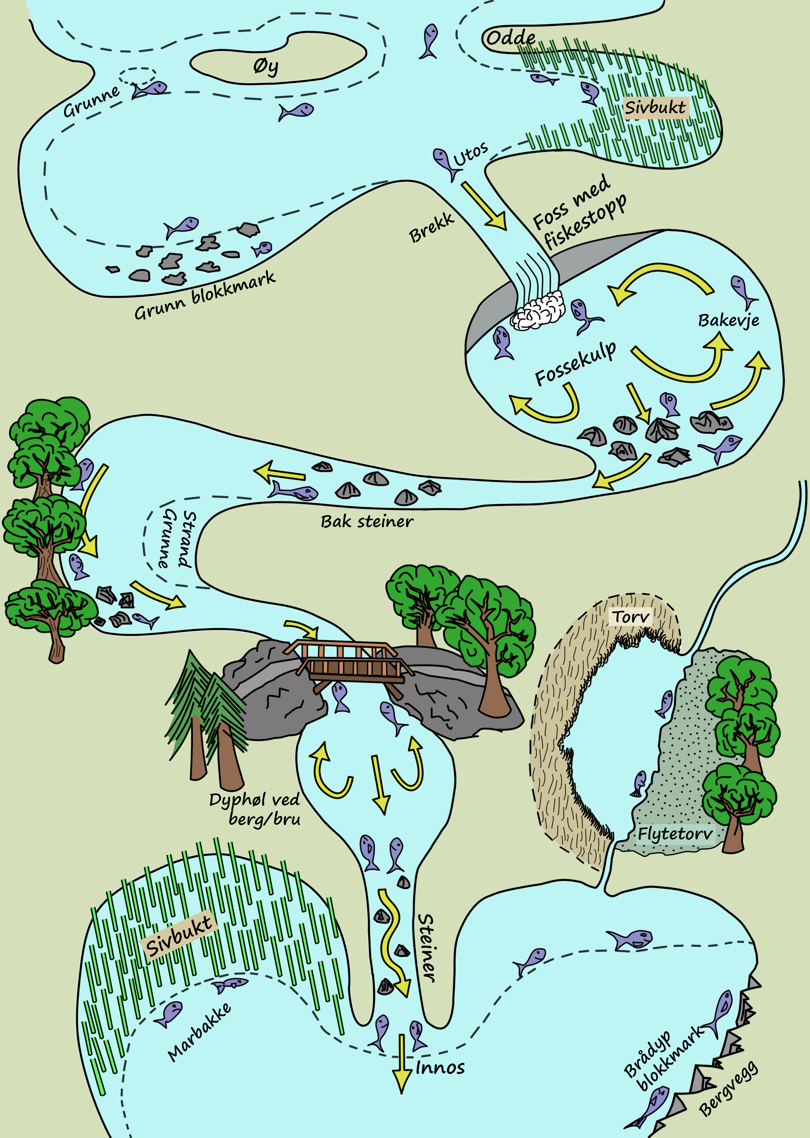
Illustration: Henrik Lerdahl
Think like a fish:
"Where can I find food while staying safe and conserving energy?"
Fish are usually found where food is abundant and shelter is available.
Good places to try include:
Along reed beds and vegetation
Near drop-offs and deeper water close to shore
Around submerged logs, roots, and rocks
In pools below waterfalls and rapids
Along current seams where fast and slow water meet
At river bends and backwaters
Around inlets and outlets of lakes
Behind large rocks in flowing water
Fish are generally most active:
At dawn
At dusk
During the night
During mild, overcast weather
Rain often washes insects and other food into streams and lakes, making fishing particularly productive after rainfall.
How to get the fish to bite?
Of course, fish bite best when they are hungry, and when they are not frightened and scared
The fish need more food and are generally more active when it is hot
The water is like a lens and the fish look over edges, never go all the way out to the water's edge
Avoid casting shade over the water, fish towards the sun and preferably along the shore in front of you
Be as silent and as inconspicuous as possible, and don't be afraid to look a little comical.
Feel free to squat or lie in the grass, or sit next to or behind bushes, trees and rocks
Rain, wind and general turmoil in the water camouflage your movements
Fish evening, night and morning, then the fish will get closer and you will be less visible
Vary the methods, vary the casting length, direction and reeling, and change colors/bait often
Small is good. Try with smaller lures if you don't catch fish.
Try with earthworms, small nook with naturally unfolded worms (do not budge)
Preferably with just hook/worm, possibly with a few split shots. As easy as possible!
Be patient! The big fish moves more and will pass you by eventually
What do you do when it bites?
Make a small counter-strike/strike to secure the hook
Hold the rod straight up, all the time with the line tight. Don't point at the fish with the rod
Adjust the reel brake so that the line does not break, but so that you still manage to reel in the line
Many lose their fish close to shore. Avoid sudden jerks, and use a net on large fish!
Quick killing by breaking the neck or hitting the head with a stick/stick/knife, if you are going to use the fish (remember any rules about minimum sizes and protections).
Bleed the fish right away by cutting or tearing over some gill arches
Do not wait too long to make up the fish and take out the blood strip (kidney)
With foil, salt and pepper (preferably butter) on hand, you can season and pack right away
Then put it on the grill/fire at the first opportunity
Boiling in a saucepan or frying on a stone slab are also goodies, but remember salt and pepper
In some places, the fish have intestinal parasites. There are many types, but none are dangerous to humans. As long as they come out with you when you make up the fish, the fish is just as good as food!
Tips for further exploration of the topic
www.inatur.no – A place for information about Norwegian waters and watercourses, and for buying fishing licenses
www.artsfiske.com – A free website for logging and recording your catches and species.
www.hooked.no – Norway's largest website for fishing