You should always assess the ice before you go out and while you are hiking. Not sure? Walk around! Here are some tips.
Frozen lakes and rivers can be dangerous. It is especially difficult to judge ice conditions when the ice is covered with snow, as weak spots may be hidden.
As a general rule, ice should be around 10 cm thick to safely support an adult. However, this depends on the quality of the ice, which can vary greatly.
A small ice axe can be used to test the thickness, but be aware that ice conditions can change significantly over short distances. Ice poles, commonly used by ice skaters, are the best tools for checking ice while you are moving.
Ice is often thinner in the following areas:
Headlands and narrow passages
Ravines and areas where water flows
Around shallow areas and rocks
Near piers or docks
At inlets and outlets of lakes
Ice covered by snow
Snow on top of the ice makes it harder to judge how strong the ice actually is. Both the ice conditions and the snow layer affect how safe it is to cross.
You can learn a lot by pushing an upside-down ski pole or an ice pole through the snow and feeling the resistance. When you reach the ice, you will often be able to feel how solid it is.
Another option is to dig down through the snow and examine the ice more closely with an ice axe or similar tool.
Follow the map
Many mountain lakes in Norway are regulated for hydropower production, which can create thin ice in certain areas. These regulated waters are usually marked on hiking maps.
You can also find updated information about ice conditions online.
Rivers and larger streams may remain partially open throughout the winter because of the current. When they are covered with snow, it can be difficult to see exactly where the river flows.
If you need to cross a snow-covered river, it is often safer to choose places where the map shows wide, calm, or deeper sections. In these areas the water usually flows more slowly, and the ice may be stronger.
Practical tips when crossing ice
If you are skiing, it can be helpful to loosen your skis if your bindings allow it. This makes it easier to move if the ice breaks.
A backpack can provide some buoyancy if it is securely fastened with a hip belt or strap. If you know that you will be crossing frozen lakes or snow-covered rivers, it is also wise to pack a complete change of clothes in a waterproof bag.
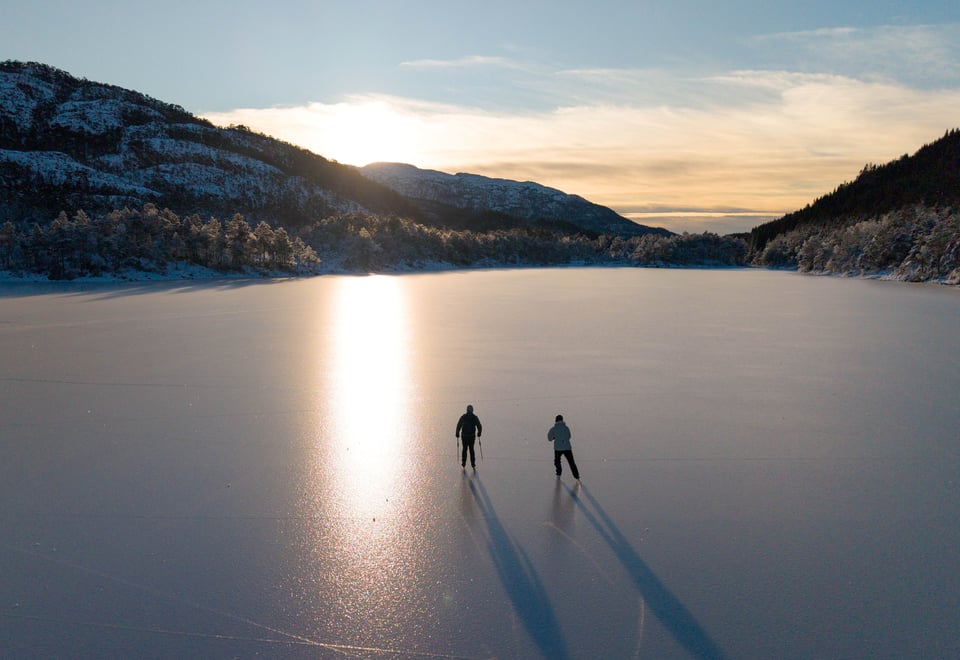
Ice skating on lakes
If you are planning a skating trip on natural ice, ice spikes and a throw rope are essential safety equipment.
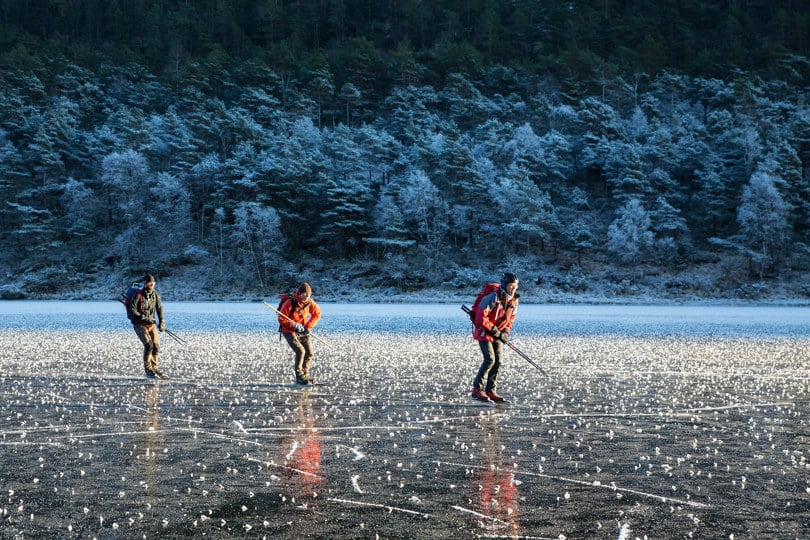
However, the most effective way to avoid accidents is to check the ice continuously using an ice pole. With a proper ice pole, you can often break through about 5 cm of solid ice with a single strike.
An ice pole typically weighs around 400 grams, so it is easy to carry on your backpack when not in use. Telescopic versions are also available.
Regular ski poles are not suitable for testing ice and can also be difficult to use if you need help pulling yourself out of the water.
Take your precautions and get fantastic trips on icy waters this winter.